Wednesday, October 24, 2012

GWTW: the 1 yard line


I was 16 hours and 44 minutes into quilting Gone With The Wind. 


[Aside: How do I know it was exactly that much time?  Well, I recently bought a nifty counter to keep track of the time I spend on projects.  This nifty timer is a "count-up" time, i.e. it counts elapsed time.  It's from CDN and is their Multi-Task Timer and Clock  Now I no longer need to keep a notebook of start and stop times ... I only need to remember to *start the timer* when I start quilting.   ::sigh:: That one little action is proving to be Very Difficult.  :-(  ]


There I was .. on the 1 yard line.  I had exactly ONE border of feathers do to and the quilt would be DONE.   I was about 2/3rds the way down the first pass of the feathers.    I could taste the accomplishment of being able to take the quilt off the frame.   ::feet doing an anticipatory Happy Dance::

I'd been having some trouble with the thread shredding at times so when I discovered that I had no top thread ... *again* ... I was annoyed but resigned.  I looked up at the threading path to grab the shredded thread ... and .. it wasn't there.  What?  I looked again.  There was NO top thread.  What?

Ever have a difficult time believing what your eyes are telling you?  That was me.  What do you MEAN there's no top thread??

Eventually, it occurred to me to look at the spool of thread.  Oh.  It was empty.

Dang, dang, dang.   ::stamp feet in utter annoyance::

Now, I need to WAIT until tomorrow to get another spool of thread from my LQS because, of course, I don't have an extra one.

aarrrgghhhhh.


The first photo above shows a shaded blue area with a yellow arrow at the end of the shaded part.  The blue shaded area is the part of the feather border that I had completed.  The yellow arrow shows where I ran out of top thread.


The yellow arrow in the picture to the left shows the same spot as above, but you can see some of the feather border that has been quilted.


And in the picture to the right, you can see the same yellow arrow pointing the same spot where the top thread ran out.

I had just THAT much left on the concave part of the spine to do to complete the first pass of the feather.  THAT MUCH.

Then, of course, I had the other side of the spine to do.

I suppose it would have been worse had the thread run out when I was THAT MUCH away from completing the second pass.  :-)  


[Addendum: you know what's really annoying about Blogspot?  No?  Well, I'll tell you.  Apparently there is NO WAY to absolutely format your post.  When I'm composing the entry, all the graphics look reasonably well place.  When I preview it,  I see there is lots of white space.  I means LOTS  of white space.  And I can't get rid of it.  Boy, that's annoying.

Yes, I know .. a First World Problem, huh?  Still .. annoying.  harumph.]


Sunday, October 21, 2012

PIQF 2012 - part 3


Let me start out by saying that I am *not* a crocheter!  However, there are times when I do want to crochet an edging.  It's always amusing to see me look for my reference documents and fumble through those first few stitches so I can get to the part where I remember, 'Oh yeah .. this is how you do it!".  :-)

Lately, I've been wanting to crochet an edging around a fleece blanket.  Everything I've seen shows the yarn being poked through holes in the edge of the fleece.  How the heck did the HOLES get there?  Do you manually pierce the fleece hole by hole?  If so, how would you keep a regular distance between the holes so the edging looked nice?

Well, a solution presented itself.

One of the vendors had these interesting rotary cutter blades that produced skipped stitches.  Sadly, I don't remember which vendor it was and their name isn't on the register receipt.  The rotary blade is from Skip-Stitch (perforating rotary blade).  It's a standard rotary blade with notches punched along the edge.  These notches leave a regularly spaced cutting edge that makes the holes/slits.

*This* is the tool that makes life easier. :-)


The vendor had 3 different versions of the blade, each one producing holes/slits at a different distance apart.  I had absolutely NO idea which blade was appropriate for what application, so I chose the middle blade, a #2.  This blade produces a hole/slit about 1/4" apart; that seemed a reasonable spacing for fleece.  (I really didn't have any idea and the vendor wasn't able to give any advice.)

Back on the home front, I pulled out a scrap of fleece, ran the blade along the edge, about 1/4" away.  As no directions came with the blade, I had no idea how far away to place the holes/slits.  It did seem to me that the 1/4" distance from the cut edge might not be enough to hold the stitch from eventually pulling through .. but ... remember, I didn't have a clue.

Pulling out my reference pages, I happily put in a row of foundation stitches and then some picots on top of that.  Oh my!  Aren't we getting fancy??!  :-)

Sure enough, that 1/4" from the edge wasn't right.  I eventually found out that the correct distance is 3/4", which allows a fold-over amount that you crochet over.
 
THEN it  occurred to me ... hey ... maybe the labeling from the blade has a website URL!  By golly it did!  Capt Obvious, at your service.  :-)

www.skipstitch.com is the place! Thankfully, they have instructions on how to use the blade effectively  AND they have explanations for what each blade was designed for.  Turns out that my #2 blade is meant for lighter fabrics such as flannel and to accommodate lighter yarns and  smaller hooks.  Well, who knew?  (The #2 seems to work nicely on my fleece sample but I suppose the original blade makes the holes/slits a little further apart, which might be desirable for fleece.. but then, what do I know?  I'll be using what I have. :-)  )

 I also found a wonderful beginner's video using the skip-stitch blade to create the holes/slits in fleece and then to crochet an edging.  This video is done by the North & Central Chicagoland Chapter of Project Linus ... so thank you, ladies, for producing a video aimed at us beginners!

If you can't find a source for these blades locally, they can be ordered from the Skip-Stitch website.

Now I have another Forever Project lined up, once I finish the current one.  :-)


PIQF 2012 - part 2


There were 3 items that I was specifically looking for while I was at PIQF: 2 Sizzix die cuts (which I was not able to find) and a specialty ruler, "Rapid Fire Lemoyne Star", developed by Deb Tucker.

I'm not a big fan of specialty rulers.  While they obviously solved a problem that someone had at some point, I really think that most of them remain unused once purchased.  I think that most of the problems solved by them can also be resolved by careful cutting, sewing, pressing and use of the standard rulers that we all have.

That being said, I do have a few specialty rulers.  The "Rapid Fire Lemoyne Star" is now one of them. :-)  I first ran across this ruler whilst cruising You Tube.  Inventor Deb Tucker has two videos (part one and part two) that explain and demonstrate how to use her ruler.   The ruler can make the star in 5 different sizes, from a 3" block up to a 12" block.

Lemoyne Stars can be a challenge to sew correctly because not only are the star points diamonds, (which can be tricky to simply seam together) but 8 of them should come together in a perfectly FLAT center.  Also, the corner background pieces and side triangles usually feature that dreaded "Y" seam.  There are a lot of opportunities for errors but this ruler eliminates most of them (it can't compensate for bad pressing!).

I've never really had a lot of problems making Lemoyne Stars but I've also been very, very careful at each step along the way.  This ruler makes those steps a whole lot simpler.  One way is to start out with strip sets to create the diamonds, rather than cutting those shapes individually.  Another is to make each sub-unit slightly larger than necessary so that you can TRIM them to the correct size before you move onto the next step.  I know, from other blocks, that if you can make any block slightly larger then trim to size, you will generally get a more accurate block in the end.  The key to this ruler is being able to trim down the diamond units accurately, using the markings on the ruler.

I was intrigued by watching the videos and decided that, if possible, I would look for and buy it at PIQF.  As I was rounding the end of an aisle of vendors, I came across a gaggle of women, listening to a demo.  I stopped to see what was being promoted .. and much to my surprise, it looked like Deb Tucker herself!  When I saw that the demo was for the Rapid Fire Lemoyne Star ruler, I knew it really WAS Deb Tucker!

my autographed Rapid Fire Lemoyne Star ruler!  woo hoo!
I will admit here, before everyone, that when the demo was over, I gushed just like a little fan girl about looking specifically for her ruler and here it was .. with her as well!  After I bought the ruler, I asked Deb to autograph it for me .. and she was very gracious about doing so. :-)  :-)

Back home, I gave the ruler a test drive.  It really, really does make creating the Lemoyne Star easier!  Deb has thought of an alternative sewing sequence that absolutely, positively eliminates the "Y" seams when sewing the background fabric to the star points.  The way this is possible is because Deb has *split* all the background pieces in half, creating a plain seam to sew instead of the "Y" seam.

Additionally, the ruler also allows you to fussy-cut fabric for individual diamonds, should you have fabric that needs to be used that way.

Here is the basic, vanilla-version Lemoyne Star. 

You'll note that the center is absolutely *flat* and that all the diamonds meet at exactly the center. 

If you use a solid or a fabric that reads as solid for the background, you'll have an easy time making this block. 

Because the block is constructed slightly oversized, the final trimming creates a block that is exactly the size it needs to be.

I tell ya, I was *really* impressed with myself at how the block turned out.


Then I got a wild idea to use a stripe for the background fabric.  You can get some interesting effects with stripes.

For this test block, I used an unevenly striped fabric.  The background strips were cut cross-wise.  You can see that it forms a miter at the corner seamlines.

With *this particular striped fabric*, even though the stripes do not match, for whatever reason, I don't find this exceedingly visually jarring.  I could live this this result.

However, if you had a different sort of stripe fabric, you might need to actually MATCH the stripes, which would be a terrifically difficult thing to achieve.


For grins and giggles, I decided to see what the result would be if I cut one background strip cross-wise (as above) and the other background strip lengthwise.  I had vague (*very vague*) ideas of being able to match up the stripes .. and wouldn't that look awesome???

As you can see, I was absolutely unable to do so.    Due to the way the strip sets are sewn and then cut to create the diamond subunits, it is virtually impossible to match any background fabric stripe or pattern.   Oh, maybe with more fabric to waste, I might have been able to find matching pieces, but it just wasn't worth my time.

*This* test block just jangles my eyeballs.  I could never live with this block at all.


Conclusion: best to stick with solid, tone on tone, mottled or overall prints for the background.  At the very least, no stripes!!!  Also, be aware if your background fabric has a DIRECTIONAL design.


There was one other tool that I purchased, that I used when making these blocks .. the Brooklyn Revolver.  This is a cutting mat on a Lazy Susan turntable.  It was invented by Pat Yarmin, who happens to *live* in Brooklyn, New York.  When she created it, it was her young son who came up with the name.    You see, not only do they live in Brooklyn, but that is where the Brooklyn Revolver is made and ... the item turns (revolves)!  It comes in two sizes: a 14" and a 9".

I had seen this spinning cutting mat in notion catalogues over the years.  Pat said there have been several imitations but they aren't as steady as hers.  On the competitors' versions, when you bear down with the rotary cutter out near the edge of the cutting mat, the whole thing tips over.  But with *her* version, it's rock-steady all the way to the outer edge.  This is due to the support structure they have on the underside.

I had a wonderful conversation with Pat and when I bought my own, I had her autograph it, too!  :-)

The main advantage that the Brooklyn Revolver gives you is that you don't need to MOVE the fabric when you are making multiple cuts.  Instead of moving the fabric (and introducing the potential for misalignment and a resultant error in cutting), you spin the revolver and the fabric spins with it.  You never, ever touch the fabric except to cut it.  This really eliminates cutting errors.

Using the Brooklyn Revolver in conjunction with the Rapid Fire Lemoyne Star ruler, produced very accurate blocks.


Saturday, October 20, 2012

Going to PIQF 2012


Pacific International Quilt Festival (PIQF) is a annual, big-deal quilt show here on the West Coast.  I try to attend every year and this year, I was happy to have been able to attend.

In year's past, I would take many, many, many pictures of the quilts .. both award winners and those that didn't.  I'm not sure why I always took those pictures, as I was never intending to replicate them myself nor did I ever find myself looking at them again.  Maybe I figured it was just the thing you did at a quilt show ... take pictures of the quilts!  To be sure, I'd share some of the pictures of the quilts with my friends so they could admire them also, but by and large, it was simply a one time admiration.

So this year, I decided that I would take pictures of specific things that I liked about a quilt.  Nowadays, I'm very much interested in the actual quilting designs (versus the piecing), therefore that is what the majority of my 2012 PIQF pictures are.

Here are some of the things that caught my eye.  I have to admit that I didn't always remember to take a picture of the info label for the quilt, so unfortunately, I can't give credit to the quilter in those cases.

I took pictures of just the quilting in this quilt.  In one of the vendor booths, a lovely quilt was hanging and the quilting replicated some of the appliqued designs.  I asked the vendor if I could take a picture of *just that part of the quilting* for my reference. 

She was skeptical but when I explained *precisely* what part of the quilting intrigued me, she was curious enough to let me show her.  I used my hands to frame the small part of the quilt and then she realized I really did mean a *small* part of the quilt.  Understandably, she was reluctant to have someone take a photo of the entire quilt when she was selling the pattern for it!  But when she understood what I wanted a picture of, she graciously agreed.

The quilt had an appliqued vine, leaves and flowers.  In addition to the outline quilting and echo quilting of those shapes, the quilter also quilted in some *imaginary* leaves in the spaces between the appliques.  I just loved this idea; I don't think I would have thought of a design element like this myself.  I hope I remember it in the future. :-)


This textural quilting design was incredibly subtle.  The entire border was done with it.  It was kinda like Baptist Fan in that there were echo'd arcs but they weren't necessarily always the same distance apart nor were there always the same number of arcs.  It was also like a clamshell in that the arcs were oriented in different directions and frequently different shaped arcs. 

In this picture, I've drawn some of the arcs in red so you can see them better.


This quilt was one of the many exquisite quilts from Japan.  The Japanese *always* do such exacting work; it's marvelous to see.   Each "rope" in this picture is made up of individual segments; I don't quite remember if they were pieced or appliqued.  What caught my interest was not the quilting nor the make-up of the ropes themselves but rather the overall design sense.  I just liked the squiggly nature of the lines. 

I would not even think about piecing those segments!  I have patience for many things, but not this! :-) 

However, I can see perhaps using bias strips to replicate this idea, although bias strips wouldn't come anywhere near the total impact of this quilt.  It's an idea that I might attempt at some point; then again, maybe not. :-)


"Kaleidoscope Weave".  Original design by Susan Lane of Vallejo, CA.

This quilt was unbelieveable.  The actual quilting was minimal straight lines but the PIECING was phenomenal.  My eye was first caught by the *bling!* of the gold lamé but upon a second .. and third .. and fourth, etc look, I realized there was a lot more going on.

Those lamé blocks seem to float over the background.  And what was the background???  Take a real close look ... although pieced, they appear to be woven bands of color.  Now, I've seen patterns available for this sort of optical illusion of woven bands; they are a fantastic design on their own.    But quilter Susan Lane has taken an extra step of PIECING the lamé bits into the pieced woven segments. 

In looking at the close-up pictures, I can almost see where the individual blocks are but in order to achieve that "floating" aspect of the lame, she needed to be *exacting* in fabric placement.

I just love the whole appearance of this quilt .. and the colors are awesome.

 Close-ups:


The quilter drafted her own Mariner's Compass for the center of this quilt.  I believe I've seen the outer arcs before .. maybe from Judy Mathieson?  What caught my eye about this quilt was the quilting done in the blue frame and outer edge of the circle.  Here is the entire quilt so you can see where the close-ups are coming from.

I've also drawn in the feathers in red so you can see them better, since in the quilt itself, they are low-key and subtle.


 This quilt is a pattern called "Rainbow Lollipops" and is from the talented mind of Kelli of "Don't Look Now!" 

The quilt was hanging in a vendor booth and the quilting was just delightful!  The pattern itself is so playful and the quilting in the vendor booth quilt was the same. 

I asked to take a picture of the quilting (before I realized it was a commercial pattern) and the vendor was very accommodating.  I bought the pattern when I realized she was selling it because I've been a fan of Kelli's designs since *forever*!  :-)


 Closer inspection of the background quilting revealed that this was an embellished meander with a 3-lobed flower.  I *KNEW* this design!  It comes from one of Darlene Epp's Freehanding books, *which I own*!  I was delighted because this is actually a quilting design that I've done before.  You just can't do this design incorrectly .... Darlene Epp shows you how to work up to this good-looking background design in easy steps.  I was just amazed at the quilting I was producing when I was working through her books. 

This is one pattern that I can honestly see myself making and replicating the quilting.  While I have all the confidence in the world when it comes to piecing tops, it's the chosing of the quilting designs that scares the dickens out of me.  I am paralyzed with all the choices that can be made, so having a design that I actually know I can do makes me think that when I get back to piecing, this quilt has a very good chance of getting done. :-)


Friday, October 19, 2012

GWTW - forging onwards.


I'm so pleased that I've finally found my groove for quilting this quilt!  To be sure, there has been a LOT of rolling and re-rolling (but NOT Rickrolling!), advancing the quilt and backing it off .. just to be able to quilt in the areas that needed to be quilted.

BUT, I'm happy to say, at this point,
  • the top & bottom borders of free-motion, meandering feathers have been done
  • all the areas that contain the appliques have been stitched in the ditch
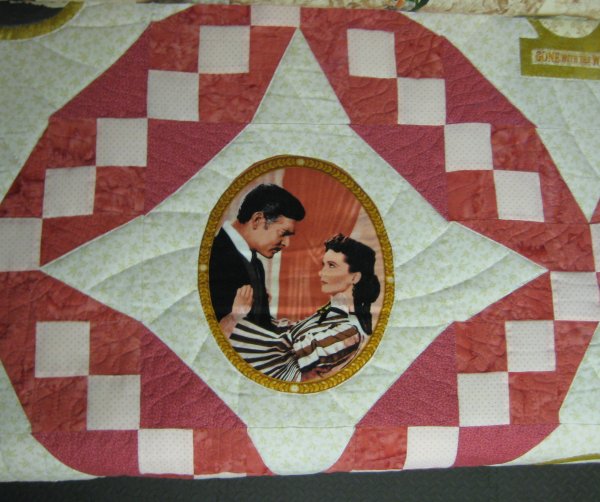
  • all the appliques have been outline stitched and have curved, radiating lines emanating from the center.  These curved lines really accentuate the applique picture, rather like a spot-light.  I hope it looks as good when looking at the entire quilt as they do individually!
  • some of the expanded figure-8 background fill has been done.  I'm sufficiently content with this design to keep it.
  • all of the tails created from the NUMEROUS starts & stops (*so* annoying!) have been tied and buried


I got the idea of the radiating lines from this picture, which I found from a Google/Image search.

I chose curved, radiating lines for a softer look than the straight lines convey.  I was able to stitch the curved lines very nicely with the use of Linda Mae's Rays curved ruler.   I bought that specific ruler because you can not only do straight radiating lines but you can also do the curved lines.  The ruler has a handy hole at the center spot so you can anchor your ruler to a specific spot on the quilt.

Next up: continuous curves in the diagonal squares.  It would be *really* nice to be able to make one long diagonal pass for as along as there are squares to stitch, but practically speaking, that's not going to happen.  My workspace is about 12" deep, so the longest diagonal that I can do is about 17" before I need to tie off and bury the tail.

Take a look at the picture above (the one with the quilted radiating lines).  There's a set of 4 squares going in a southeast-to-northwest direction.  All of the squares in that direction can have the continuous curves quilted in one pass.

But the squares going in the southwest-to-northeast direction don't stop after four squares ... they continue on and on and on.  Those are the ones that I anticipate just a whole lot more rolling and re-rolling to get stitched.

My goodness, there is just no END to this quilt!  I don't think I'll be ever making this particular layout again!  :-)


Tuesday, October 16, 2012

GWTW - détente


I think that Gone with the Wind and I have reached an understanding.  It's a bit tenuous but workable.

I've been able to find a reasonable pathway for the diagonal bits that will decrease the number of stops & starts (hence, tails to be buried).

Unfortunately, the LARGE blocks that have the appliques in the middle are too large for Lizzie's workspace.  I can't stitch in the ditch the entire thing; I need to do half the SITD; tie off.  Do that for each of the blocks across the width.  Advance the quilt in order to do the other half of the  SITD.  Tie and bury all the tails.

BUT ... once all that SITD has been done, the quilt  will have been stabilized from top to bottom.  I will then have only one layer to contend with ... yahoo!!!!   It's much easier to advance, roll & re-roll the quilt if you're only dealing with one stabilized layer.

I'm hoping to get to the one layer stage sometime tomorrow.


Here's a gratuitous picture of when I first loaded the quilt onto Lizzie.


This is the top border.  The coral triangle have a loopy design in them that looks like a Christmas tree.  A Christmas tree has absolutely nothing to do with the theme of the quilt, but it sure fits the space!  :-)

The narrow sashing has a traditional Egg & Dart design.  It has other names but I can't remember them right now.

The light fabric between the coral triangles is now quilted with a meandering feather.

OH!!  Once I have the quilt at the single layer stage, I need to remember to roll it back to this position to see if I thought to do an outline stitch around the edge of the feathers.  I bet I didn't. 

I was told by a fellow quilter recently that "all the best dressed feathers have outline stitches these days"!   Well, we certainly wouldn't want under-dressed feathers, would we?  :-)


Monday, October 15, 2012

GWTW - continuing the whine


Have I mentioned that quilting GWTW  is a PITA?

I'm continuing to do the expanded figure-8 in the odd angled coral colored areas.  The *point* is to treat the area as ONE section, regardless of the seam lines.

However, I am *so used* to thinking inside the box (literally!) that there have been several times when I have stopped at a seamline instead of stitching over it.

aaarrrggghhhh!

That means more quality time with Jack the Ripper so that I can resume the stitching and THIS TIME, go into the next section.

aarrrgghhhh!

Did I also mention, although you might have been subliminally aware of it from the previous blog's pictures, that these areas are on a *DIAGONAL*?  On a longarm, any longarm, even the big 26" longarms, you simply can *not* stitch a diagonal from one side of a quilt to the other in one pass.  You need stop, release the side tensions, release the locks on the rails and advance the quilt so the next section can be quilted, re-set the locks on the rails, re-set the side tensions and then resume quilting.

Diagonal quilting on a longarm is really, really, really obnoxious.  

My goodness, who pieced this monster???  And who decided against and edge-to-edge design?

Oh yeah.  That would be me.  ::sigh::

Really .. honestly ... I'll be so happy when I'm done with the center section of this quilt.  By contrast,t he sashings and outer borders are child's play.


GWTW - still working on it


I've had an off-and-on relationship with the quilting of Gone with the Wind.  After waiting for a while for my niece to decide what design she wanted (from those I suggested) in the outer border, I lost my mojo for a while.  The poor quilt languished on Lizzie.

 Then a returning client got in contact with me to schedule a quilt with me.  Whoops .. that meant that GWTW had to get done like Right Now.  So, the feathers were promptly quilted in the outer border.  Ya know, it wasn't that difficult.  Why did I wait?  :-)

But then came the *really* difficult part.  The center pieced area of the quilt was made up of some very strange angles.  If I hadn't made the top myself, I would swear that I'd never quilt anything pieced by "that person" again! 

The light colored squares would get continuous curves.  I like the look; they are easy to quilt.

But see all those the coral colored areas?  Oh My Gosh.  Those have been a continuing nightmare for me.  I have been completely stymied for a design that looks nice, is (relatively) easy to quilt and goes with the rest of the quilting.  I didn't want something that looked like "oh, she just stuck something in there".

And then the thread color!   If I used the same color thread in the continuous curves as the coral areas, it would blend in the squares but be contrasting in the coral areas ... I really didn't want that look.  If I used a color to compliment the coral, it would stand out against the light colored squares.  Ugh.

That meant that I would necessarily need to change colors between the small squares with the continuous curves and a different thread color for the coral areas.  Ugh .. I try to minimize the stops and starts because not only is it time-consuming but I tie and bury all the tails.  Ugh.
 
One idea was for a three-pronged spikey thing.   I actually did stitch out one coral area with this design and instantly disliked it.  It didn't go with *anything* else on the quilt. 

I spent some quality time with Jack the Ripper and removed it.

Next idea was a 3-lobed fan and a four petaled loopy thing.  I could do continuous stitching for this design but I wasn't enamored with it.

This design: discarded


Another plan was to do feathers in the coral areas.  This would tie into the feathers in the outer border.  So I put a vinyl overlay on the top and drew in some feathers with a dry erase marker.  (The blue line you see is painter's tape that marks the edge of the vinyl).

You can see that I drew several different styles of feathers.  The ones to the right are stylized feathers.


and the ones to the left are more traditional feathers.

I didn't choose any of the feathers; I think I actually forgot I had done them.  whoops.  :-(


What I ended up stitching was a loose loopy thing, sort of an expanded figure-8.  Below is a picture of the actual stitching on the left and the same area with the stitching drawn in on the right.   I deliberately chose a thread color that matched the coral fabric.  You can't really see the quilting.  I wanted that effect (or lack of it).  There is so much going on in this quilt that I didn't want a quilting design in this area to be competing for attention.  I just wanted a background fill sort of design.  This quilting design flattens the area, which is also what I wanted; it will allow the other areas to puff up a bit.


 See that triangular area?  That's another problem area.  I think I'm going to do a continuous curve in it also.  The radiating lines I have in the other triangular areas would look exceeding odd is this isolated piece.

So, at this point, I believe I have all the areas to be quilted identified with what I'm going to put in them.  It's been a *real* bear.   Gosh, I never want to see this layout again!


Monday, September 24, 2012

It's been One Of Those Days.


In my previous entry, I had a picture of the Jordy Tote bag I just finished.   Nice picture, huh?  Wouldn't you have liked to READ about it and see more pictures??

::sigh::

Yes, I really DID create a webpage for it.  That's what most of today's time was spent on.  Did I *include* a link to the page on the previous entry?

Nope.

Well, you can't say that I'm a complete doofus because I assure you that parts of me are missing.  And of all the things I miss, it's my mind that I miss the most. :-)

 So let's just REPEAT the picture and this time ..

INCLUDE THE LINK to the web page, huh? :-)

If you'd like to see more pictures, read about all the gory details regarding the customizations I did to the basic bag and get to the links I used to create this bag, please surf on over to The Jordy Tote Bag.  :-)


A new sewing project: the Jordy tote bag

Two items for this entry ...
1. There are now 2, count 'em TWO, tabs at the top of the blog!  I've created a new, second tab that is a page for a slide show of the quilts I've done.  I like the idea of you, The Viewer, having the ability to look at the quilts in this manner. 

There are 155 images.  Since I know I have done almost 200 quilt, this means that I'm missing a few.  ::sigh:: There's another project ... see which quilts are in the slide show and which ones are not .. then add the missing ones to the slide show.

There's no text to go with the images; it's just the pictures.  They are in no particular order.  If you want to read all the gory details, you still need to visit the website, Dread Pirate Rodgers.  From there, click on the "I love to quilt" link.  :-)

Having said that, I'm not 100% enthralled with this particular slide show.  I'll be looking around for a potential replacement.  Sometime.  :-)

2. Just because I've said that I really, *really*, REALLY need to get a whole bunch of tops quilted and finished AND just because I have a top already loaded onto Lizzie with some quilting done doesn't mean that I can't be distracted into a completely different project.  :-)

 The middle Pirate daughter requested a tote bag of a specific size.  I allowed myself to procrastinate on the quilting to make the tote bag.  It didn't take too long to make, even with the various customizations and back-tracking due to the fact that SOMEONE might have sewn something (or two somethings) incorrectly  ::ahem::

But, the tote bag is now finished and ready to be mailed.

And it's time to return to Lizzie and resume that quilting!  :-)


Thursday, September 13, 2012

Opinions requested for border quilting

Here is what the outer border looks like:


I have two candidates for quilting this border: one is meandering feathers, the other is a combinations of elements (curved cross-hatching, ovals between the coral points and piano keys outside the ovals).

Both designs replicate elements found in the interior of the quilt, so they aren't "designs in a vacuum".

To help me make up my mind, I sewed a same-size, sample border using the same fabrics as in the quilt.  For me, both designs have the same difficulty level, i.e. one is not significantly easier or more difficult than the other.  The feathers are free-motioned after the spine has been chalked in.  The cross-hatched design involves a number of templates but is mostly continuous thread designs (there are few starts and stops).

I'm still in a quandry.  I like both of them. :-)

Sooooooooooooooooooo ... I would appreciate some outside opinions, please!   If you are so inclined, I would appreciate it if you would leave a comment saying if *you* like one design over the other or if you like them both.  There is no right or wrong answer; it's just your personal preference.

Please disregard the discrepancy in colors ... I had to photostitch the blocks together and the lighting was different.  Also, I didn't have a fabric corner for the cross-hatching design; instead I drew it  so you could see what it is supposed to look like. :-)

Here's the feathers:


And here is the curved cross-hatching design:


Thanks so much for your opinion!  :-)

Saturday, September 01, 2012

Quilting schematic: alternating continuous curves & a flower

I'm pretty sure I recently lied to all of you.

I posted an entry for a quilt I made in 2010 but only now got around to making a gallery web page for it.  The blog pointed to the gallery page:  4-patch and Straight Furrows quilt .   On that page, I showed a drawing of the continuous curve variation and a drawing of the spiral flower I quilted in alternating blocks.  Since the web page was done 2 years AFTER the quilt was finished and the quilt was given to my sister-in-law, my memories of *exactly* what I did is a little hazy.  I don't have the quilt in my possession to examine, so I was basing my blog entry on looking at pictures that I had taken at the time.

One of my quilting buddies asked for a more detailed explanation of how I did what I did.  Once I started thinking about it, I believe I didn't do what I said I did.  :-)  My apologies.  :-)

But, I've now re-thought the quilting process of alternating the continuous curve variation and a flower block and have come up with what I believe is a viable schematic.

I drew a 3x3 grid for demonstration purposes.  Your quilt probably won't be a 3x3 grid but if you understand how this quilting path works, then you can adapt it for your own quilt.

Here's the overall schematic, showing the path for the two different blocks.   At first glance, it looks complicated, but DON'T PANIC!  :-)   It's not.  It's kinda like painting the Golden Gate Bridge (a common analogy out here since everyone has first-hand knowledge of how BIG the Golden Gate Bridge is).  If you look at the entire process, you'll run away,  screaming in terror.  But, if you break it down into smaller and smaller sub-units, all those small sub-units are very doable.  Eventually all the sub-units get done and suddenly the entire thing is done!  :-)

Remember, you can stop the quilting process at any time, but if you do, I suggest you find an appropriate stopping point, such as at a corner or when you finish a block.  I don't advise stopping in the middle of a design or, heavens forbid, in the middle of a curve!   It is just about impossible to restart nicely at such points.  Make it easy on yourself.  :-)


I know you're thinking, "oh my gosh ... how the heck do I interpret that??"  Well, you don't have to!  I've made a PDF in (what I hope is) excruciating detail that tells how to do the inner motif of the continuous curve blocks and the flower design.    I explain why I'm using different colors and what that mysterious green star is for.  I have detailed diagrams and descriptions on what piece to quilt next so that you are set up properly for the next motif.

There are two different designs here: a continuous curve variation and a spiral flower.  All the continuous curve blocks can be done in one path.  All the flowers can be done in one path.  But, the diagram shows each motif being done as separate quilting runs.  (a further thought is at the end of this entry, since I thought of it after I made the PDF.)


Here's the diagram for the inner 4-petal curves in the continuous curve blocks:  


and here is the diagram for the spiral flower:


Now ... as the overall diagram is drawn, you start (and end) the continuous curve blocks in the upper left corner.  As I look further at the overall diagram, it occurs to me that *IF* you started the continuous curve in the *upper right corner of the topmost left block* (i.e. where the blue arrow is), you would also *end* there ... and then, you'd be set up perfectly to start the spiral flower motifs.  This would make the ENTIRE quilting design ONE path.  One start.  One stop.  Awesome.  
 :-)


So, if you missed it earlier ... diagrams and instructions for quilting the continuous curve and spiral flower designs is available in a PDF.  Enjoy!

Friday, August 31, 2012

4-patch and Straight Furrows

All righty then ...  this is the last after-the-fact quilt I'll be posting for today!

Once again, let us journey back to 2010.  No, wait .. let's go further back than that ... back to 2005.

I was hand-piecing 4-patches.  Lots of 4-patches. I needed to be doing something "historically accurate" for a re-enactment Gold Rush mining town in the 1850's.  I made so many 4-patches that they were practically coming out of my ears.  The quilt for which they were intended was finally pieced in 2009; quilted and bound in 2010.

And I had a lot of 4-patches leftover.  A lot of them.

So, I made another quilt from them.  This one, "4-patches and Straight Furrows".  It's a free design from Bonnie Hunter's website but I changed how the borders look.  This quilt was pieced in 2010 and quilted in 2011.

I was doing a LOT of piecing (of a lot of different tops) in 2010; it was as though I was on an assembly line of piecing.  As soon as I finished one top, I dove right into the next one.  Not all of them got webpages made on a timely basis.

I've been updating the gallery pages on my website (man, just a whole lot of BORING technical things to change!) and I figured I probably should make web pages of the quilts where I could.  Hence the 3 new pages today!

Anyway, back to those 4-patches.  I thought I was done with them.  But no.  Oh no.  Little did I know that they were lurking around like dust bunnies.  I made another bed-sized quilt and two toddler quilts with excess 4-patches.  And ya know what?  I recently found SOME MORE!  My goodness ... where is the contraceptives for 4-patches????

So, during the website update, I made a page for this quilt ... there's lots of verbage and LOTS and LOTS of pictures, particularly of how I did the quilting.    The page is 4-patches and Straight Furrows.  :-)