Thursday, July 21, 2016

The Tale of Two Rotary Blade Sharpeners

Caution: this is a LONG product review of two different rotary blade sharpeners but I wanted to give y'all the full description.  I purchased both of these items on my own; neither manufacturer offered me anything to review and in fact, they have no idea that I even bought their units!  So, this is *my* experience and I wanted to share it with you.

Like every other quilting these days, I have an inventory of rotary cutters.   I have the original 28mm (excellent for zipping around small curves), the 45mm and the 60mm blades.  I've more or less settled on exclusively using the 60mm because you can cut so much faster (or so it seems to me) than with the small blade.

I try to be VERY careful and not run over pins or other obstructions but just the other day, doggone it! a pin was hiding from me and, sure enough, I nicked my blade.  I was really, really, REALLY annoyed because I had only recently replaced that 60mm blade.  That size is *expensive*.  Ouch.  

Being the stubborn person that I am, I was NOT going to replace that blade for one silly, annoying nick.  So, I carried on.  Every time I was cutting a length of fabric, that little nick would cause ONE LOUSY THREAD not to be cut.  That meant I needed to either snip that one lousy thread with scissors or run the rotary cutter again.  Sigh.

At that time, I didn't have a rotary blade sharpener.  They're expensive and I just didn't want to lay down that kind of money at one time.  (Oh hush!  Don't judge me on spending that much (and more) on fabric!  TOTALLY different scenario!)

Well, after being annoyed once too often regarding that one lousy uncut thread, I decided it was time for me to *invest* in a tool .. a sharpener that would allow me to use my blades just a little longer.

I did some basic research .. not any great depth or nit-picking .. but I looked at a few, read the reviews and the one that caught my eye was the "TrueSharp Power Rotary Blade Sharpener".  It looked like it was quite well throught out.  It was electric, would sharpen *all* my blades .. the 28mm, 45mm and 60mm .. so it was versatile.  It had a hinged lid that would exert the same amount of pressure every time, so there would be no guess work as to how hard should I be pressing down.

Amazon delivered the unit promptly (YAY, Amazon!) and I promptly put it to the test.  Remember that my 60mm had just ONE little nick in it.  The rest of the blade was as sharp as ..well .. a razor.  :-)   I must say, at this point, that the directions *did* explicitly say that nicks in the blade might not be corrected.  Hmm .. oh dear .. the one thing that I wanted the rotary blade sharpener to do.  But .. nothing ventured, nothing gained.  (I did bite the bullet and purchase a replacement 60mm blade, so using the nicked blade in the sharpener to see what it could do was not going to do irreparable harm.)


So I thought.  The thing to remember is .. the blade was basically 99% good.  It cut wonderfully, other than that annoying little nick.

I followed directions explicitly.  It said that you might need to sharpen a blade a couple of go-rounds the first time .. fair enough.   I ran the blade through the sharpener for the specified amount of time.  Then I ran the newly sharpened blade over a piece of quilting cotton .. which is normally what I'm cutting.  HOLY MOLEY, the blade was AWFUL.  The blade actually cut WORSE than when I started.   I was shocked .. really dumbfounded.

OK ... they had addressed this possibility by saying you might need to do the first sharpening a couple of times.  So, I did.  And each successive "sharpening" made the blade worse and worse.  I ended up with a completely DULL blade, whereas I had a mostly sharp blade to begin with!

Conclusion:  Do NOT NOT NOT buy the "
TrueSharp Power Rotary Blade Sharpener".  It is a worthless piece of machinery that not only does NOT work as advertised but actually leaves you worse off than when you started.    Fortunately, I was able to return it and get a refund.

But .. that left me in the same position I was before .. if and when (because you KNOW there is going to be a next time) I nick a blade again, I still won't have a sharpener.  By now I was determined to have one.  
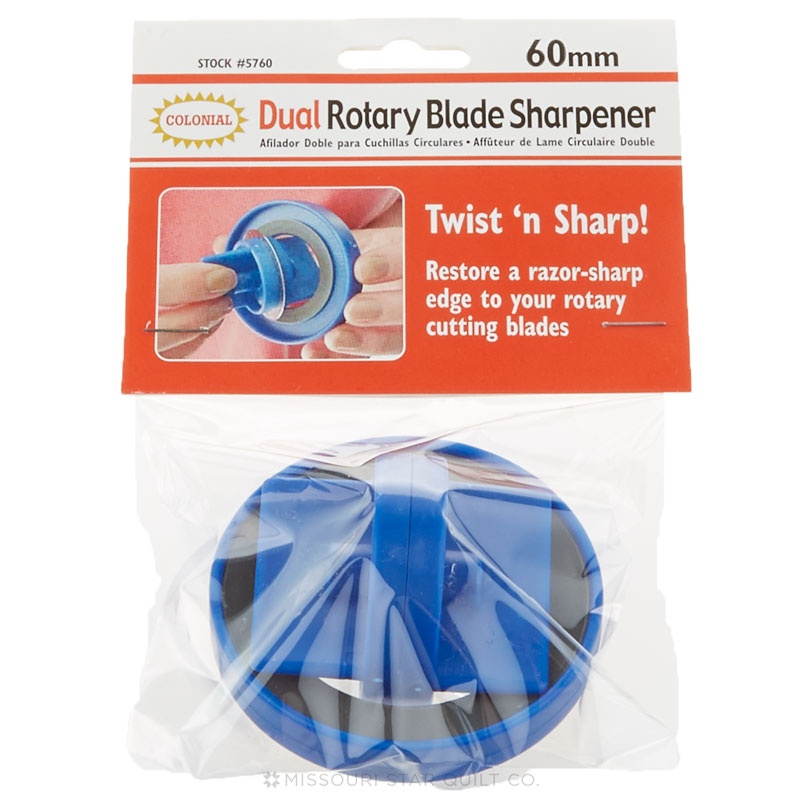

The next sharpener on my list was the "Dual Rotary Blade Sharpener" by Colonial. Now the downside is that this unit is a manual one ... when you put the blade in the unit, you must manually twist it against the sandpaper 10-20 revolutions.  If you have hand/wrist mobility issues, this could be a problem.   The other downside is that it is made for a specific size blade; the unit you buy for your 60mm can't be used for the 45mm and vice versa.  BUT, I really did want a sharpener, so I ordered it.

When it arrived, I decided to use the ruined 60mm blade as a test.  Honest to goodness, it couldn't be made any worse than it already was.  Once again, the directions did explicitly say that nicks might not be able to be corrected.   Oh dear .. what *is* it about nicks?  Well, nothing ventured, nothing gained.

I put the dull blade in the unit and twisted it manually 20 revolutions on the sand paper.  When I tested the blade on a piece of quilting cotton ... HOLY MOLEY!  It was sharp again!  Not completely sharp, but realize that the other sharpener had made it completely *dull*.  So, I repeated the sharpening procedure once again ... 20 revolutions .. and cut another piece of fabric.  HOLY MOLEY!!   I had a completely SHARP blade again .. and the nick was gone!


Conclusion: I enthusiastically recommend Colonial's "Dual Rotary Blade Sharpener" unit.  It does exactly what it says it will do.  BE SURE TO GET THE SIZE FOR YOUR BLADE!!    Look around and you'll see different price ranges.  Do take into account that a lower base price might not include postage, so beware.   It also looks as though Dritz makes a similar unit, although I did not buy the Dritz and have not used it.   

I hope this is helpful to anyone who is looking at buying a rotary blade sharpener.


Friday, July 01, 2016

UFOs completed in June 2016

Now, bear in mind that these "completed" UFOs are *only* tops.  They are NOT quilted (yet).  I have been making a truly concerted effort to sew the UFOs I have laying around .. whether they are commercial kits, projects kitted by myself (i.e. contains the pattern & fabric), or bagged works in progress.   The actual *quilting* is a completely different effort to be done at a future date. :-)

I previously blogged about the trailer placemats, the 4-patch Posey One Block Wonder, the self-mitered baby blanket and Shadow Box quilts, so this post will be for the tops I have completed since then.   I really have been on a roll and feel pretty doggone good about it. :-)


* "Majestic Mountains", designed by Ray Steeves of the 3 Dudes Quilting in Phoenix Arizona
Every year, I attend a quilting Retreat in Phoenix to meet up with my online Delphi forum quilting buddies.  Our hotel is just across the intersection from the shopping center where the 3 Dudes Quilting shop is.  The Dudes are always very nice and devote one evening of a demo or something just for us.

In 2011, Ray showed us his newest (at that time) pattern, which he called Majestic Mountains.  The pattern calls for sewing strip sets from jelly rolls but for our demo, he wanted to show us the shortcut .. using striped fabric instead of making a strip set.  We got a sheet of instructions.  

In our Retreat goodie bag, we had received a gift card to the Dudes and it was burning a hole in my pocket.  So, I looked around for some striped fabric.  (Realize that this was back in *2011* and this being 2016, my thought process at that time isn't all that distinct).   I found two striped fabrics and bought enough to make the pattern. 

Upon my return home, I prompted put the pattern and striped fabric away.  It emerged just now (June 2016).  In comparing the pattern photo and the striped fabric that I bought, I was thinking that perhaps the striped fabrics were just a little too similar to offer a nice contrast to each other .. but it is what I had bought and I certainly didn't have another use for them ... so I simply made up the pattern.

I'm not *thrilled* with it but that could be because of the striped fabric I chose.   It certainly was an easy enough pattern to construct.

* "Beyond Horizons", designed by RaNae Merrill for Blank Quilting
This pattern features using ombre/gradient fabric.  It's a striking modern/contemporary design that caught my eye not only for the unusual layout but the use of gradient fabrics.  I have a nice stash of that kind of fabric simply  because the color changes were so pretty!  I had no idea HOW I was going to use them when I bought them, but this is the pattern for sure!

This pattern *used to be* a free download from Blank Quilting.  However, it's not there any longer.  Neither is it available at the designer's site.  BUT ... due to sheer, doggone persistence, I *found* an archive site where it *is* still available.  Soooooo ... if you like this pattern, I strongly suggest you download it from the archive site NOW and just file it away for future use. The archive is here.

What I really liked the most about this pattern is the optical illusion of the way the stripes flow from one edge back around to the other edge.  I'm going to do a faux trapunto behind the circles, to give them a little bit extra dimension.

 The circles are appliqued.


* Hexagon One Block Wonder

The progress of this quilt was previously blogged about but now the top is done. 

I had made all the hexagons that I possibly could from the fabric that I had but when I sewed them all together, there were quite a few "void" areas ... I couldn't create a rectangular interior but needed to have one.  From another online quilter, I read where, in a similar situation, she simply appliqued the base fabric onto the hexagons until she *did* have a rectangle.  Because the base fabric is such a large scale floral print, unless you looked VERY closely at the edges (of the interior rectangle), you'd never, ever be aware that the entire thing wasn't made of hexagons.

After the yellow stop border, I put a white, wavy resting border and *then* the piano key border.

That white wavy border is constructed in a VERY sneaky way!  I didn't think of it, but saw it demonstrated in a Fons & Porter You-Tube video.  What you do is to sew a plain, standard (in this case, white) border next to that inner yellow border.  The edges of this border *will be straight* at this point.  You create/draw the wavy edge on a long strip of paper and trace that wave onto the outer edge of the white fabric.

Then you put the piano key border (or whatever border you want) UNDER the edge of the white border, making SURE that the raw edge of the piano key border is completely covered by the wavy border of the white strip.  Then you BASTE the wavy line down, connecting the two border fabrics.   You then APPLIQUE the wavy strip to the piano key border!!  Isn't that the sneakiest technique ever???  I love it. :-)

I have enough of the yellow fabric to make the binding from it, so it will match the inner yellow stop border.

* "North" a pattern and fabric from The Cloth Shop, Granville Island, Vancouver, British Columbia

Mr. Pirate & I recently took a 2+ week road trip with our new-to-us small travel trailer up to the Pacific Northwest and even further north, into British Columbia.  One quilt shop that we visited was The Cloth Shop on Granville Island in Vancouver.   The shop itself is tiny-tiny but has just a whole lot of interesting things to see.  I was looking specifically for some fabric that would remind me of this part of our trip. I had already purchased a Canadian Maple Leaf design, so I didn't want that.
What I did find was a pre-packaged set of coordinated fabrics ("North") and a "pattern" to make a horizontal strip quilt.  These fabrics were reminiscent of the Canadian northwest and their indigenous peoples.

I also found the most AMAZING "fleece" fabric.  It's polyester on a knit backing, so it's not going to ravel and is the most luxurious, soft and cuddly fleecy stuff on the front.  Not quite like Minky or Cuddle but similar.  I bought enough to be the backing of a personal sized throw.

In fact, because of the width of the pre-packaged North fabrics, it turned out that I could actually make a self-mitered blanket with the fleecy stuff, instead of doing a traditional binding.  So that's what I did.  Whoa .. this throw is seriously soft!  :-)


* Beads of Courage bags

Say what?  What is this?  Well, Beads of Courage is an organization that gives "milestone" beads for kids undergoing cancer treatments.  It's tough enough when you are a child to have such a terrible disease and every little thing that can distract them  or make them smile is welcomed.  The milestone beads are threaded together to make a necklace.  Sadly, some kids acquire a LOT of beads and their necklaces are very, very, very long.

The kids need a place to store their necklaces and/or loose beads and that where the bags come in.  Beads of Courage has directions available to make bags in two sizes.   They are simple-simple to make, even beginning sewers can make them.  While the samples I've seen show bags made from a single piece of fabric, I used up orphan blocks, strips and pieces to make the bags .. making sure that the bags fit within the stated size criteria.

On the aforementioned road trip, I was able to make 10 bags and here are the ten bags that I was able to finish ....

 Sharp eyes will notice that the bag on the far right has a woven label on it.  These are specific labels that Beads of Courage will mail to you  .. these are their own labels.  There is no cost to you for getting the labels and each bag needs to have one of these labels on it.


and this is how they look when the drawstring is gathered up.

If any of you would like to make a small difference in the life of a child undergoing cancer treatment, please consider making some bead bags for them.  They are quick, easy and very gratifying.

Beads of Courage website

bag directions (and label ordering)


Saturday, June 18, 2016

Catching up with completed tops


Since we returned from our road trip to the Pacific Northwest, I've been looking at the piles (yes, *piles*) of laundered fabric that was my haul from all the shops we visited.  Some I purchased with specific projects in mind, others were bought "just because".  But NONE of them were on my existing UFO list ... the list I have been steadfastly trying to reduce for lo, these many years  (no kidding on that, either).

Effectively, what I did was increase my list of Projects To Do.   Sigh.  But the fabric was so pretty!  :-)

In any case, here are the completed TOPS ONLY (quilting is a completely separate project) that I have done since we returned (um, which would be 1 week and 2 days ago).  These tops were made (mostly) with fabric I obtained on our road trip ... the fabric never even made it into the General Population.  :-)

* 4-Patch Stacked Posey  (or a One Block Wonder/4-patches)
original fabric
I knew, *knew*, KNEW that I had this pattern someplace.  I had previously looked in all the usual places without success.  Then, I rediscovered a storage box tucked into a low bookcase and TA DA!  there is was ... along with a LOT of other patterns and supplies that I had kinda/sorta forgotten about.  Quite literally .. out of sight, out of mind.

The pattern is "4-Patched Stacked Posies" from HD Designs.  They haven't got their act together with respect to their website but you can see the pattern itself over on Amazon

I wasn't real *thrilled* with the outcome of my version.  The pattern calls for
sashing, which I didn't want to do.  But I had seen some absolutely fabulous versions with the 4-patches just smooshed up against each other. 
4-Patch Stacked Posies top only


Maybe I didn't group them as well as they could have been grouped.  Maybe my fabric wasn't the greatest choice to begin with.  Whatever the reason, the center part of the top, where all the 4-patches are, looks like an incredibly busy mish-mash.  I could have achieved this same look by simply using the fabric as-is.  Eh .. whatever.  It is what it is.

The red inner border fabric and the black setting triangle fabric came from my stash.


* Shadow Box / Illusion
I've made this layout before; it's a great optical illusion of 3D boxes with shadows.  The pattern is "Shadowbox" by Mountainpeek Creations.  Interestingly, I couldn't find *my* pattern on their website .. really weird ... but you can see a version of it on Kaye Woods' site.

My "focus" fabric was the ADORABLE green & blue sheep fabric.  There was also a coordinating blue dot fabric.   My original intent was to make a self-mitering baby blanket for an upcoming baby shower .. which I did.  Hooray!

(and then I found out that the gender of the yet-to-be-delivered baby was female and this blue/green version looks more masculine to me (although blue is MY favorite color and I'm not masculine at all!).  So I made another self-mitered baby blanket, using more "girly" fabric.  Heh .. I get to keep the sheep blanket!)

But, I had quite a bit of the fabric leftover, which is where the Shadowbox quilt came in.  Although I had many leftover sheep and blue dot rectangles, there weren't enough of them, by themselves, to make a Shadowbox quilt.  I augmented with a green flannel.  The black shadow, the white sashing and green flannel fabric came from my stash.
Shadowbox version 1


Shadowbox version 2
When I got done with that one, I STILL had some leftover rectangles.  I had gotten carried away when cutting the green flannel fabric.  :-)   In order to use it up, I made ANOTHER Shadowbox quilt.  To make the quilt top a useful size, I used some more compatible blue fabric from my stash.


* which leads us to my current, in-progress quilt top: another One Block Wonder but this time with hexagons.

original fabric
Now THIS version is what I had in mind when I was making the first one (with the 4-patches).  Maybe the original fabric (a Kaffe Fassett print!) was better suited.  Maybe the hexagon shape is a better choice.  Whatever the reason, I'm very pleased with the way this one is progressing.

I had bought the rest of the fabric available at the shop, which was about 3-3.5 yards.  I thought SURELY this would be enough for a One Block Wonder (of some sort).  Well, what I hadn't remembered is that the length of the pattern repeat on the fabric plays a HUGE role in how much fabric you need to make the hexagon version.

For hexagons, you need 6 triangles ... i.e. you need 6 repeats of the fabric print because you are going to stack those repeats vertically on top of each other to get your 6 triangles.  From the fabric that I bought, I *was* able to get 6 repeats (whew!) and 2 more .. which means that all the hexagons I was ever going to get would be from that single stack of 6 repeats. 
green outlines the "voids"

Depending on how you sew the triangles together, the look of the resultant hexagon will be wildly different.  The predominant color will change as the position of the triangles change.  You never know how many hexagons of a particular dominant color you are going to get until you sew all the hexagons.

So, with the colors that emerged from my hexagons, I moved them all around .. repeatedly! ... until the final result was something that pleased my eyeballs.  There is no right or wrong way to group the hexagons; it's whatever looks good to you.  When I was satisfied with my final arrangement, there were quite a number of "voids" ... areas where I didn't have any hexagons to be used.

Googling what others had done with their One Block Wonders, I saw where one enterprising quilter had simply appliqued the hexagons on top of the original fabric to fill in the "voids"!  WONDERFUL idea!  I even had enough leftover to do exactly that!  I was very, very pleased!

voids filled and 1st border
So, here is the version where all the hexagons are sewn together ... the green dashed line shows where I need to fill in with the original fabric.

And here is the filled-in version, along with a narrow stop border.  This is where I am right now.  Since I don't have a substantial amount of original fabric to use as an outer border, I need to think a while to figure out what kind of outer border to put on it.


Saturday, June 04, 2016

Cannon Beach, OR - a project finished!


Recently, Mr. Pirate & I went on a road trip. Mr. Pirate recently acquired a new-to-us, small travel trailer and one of the places we stayed was at the Cannon Beach RV Resort in Oregon. This was just an overnight stay for us, so we didn't have a whole lot of time between the time we arrived in the late morning and the time we needed to be on the road again, 24 hours later. 

We did relax, have dinner and a campfire.


BUT, we made good use of the time that we did have.  Specifically .. a quilt store!  Yep, Cannon Beach has a quilt store.   A very NICE quilt store.  Mr. Pirate usually looks for a nearby pub/tavern, as he knows that I can be quite a while at quilt stores.  He has resigned himself to this, so he looks for a place where he can consort with the locals in a friendly setting .... and that is usually a pub.

And wouldn't you know it?  There WAS a pub just a mere block away.  Now this isn't JUST a pub.  Oh no.  By some strange set of circumstances that we never did get a straight answer on, the owner of the pub is also the owner of a hardware store.  He decided to join the two businesses.  I mean *physically* join them in the same building.  You enter one door; to the left through an opening, is the hardware store.  To the right, is the pub.  You pay for your hardware purchases at the pub. 

The name of this conjoined business?  Wait for it .... the Screw-n-Brew.  :-)   I kid you not.  :-)

So, while Mr. Pirate whiled away the time over a glass of porter (yuck! yuck! yuck!), I devoted MY time to carefully perusing the inventory of the quilt store, Central Diamond Fabrics.


It is a FABULOUS store.  The building is long and narrow but inside is an incredible inventory in both fabric and books.  Because this is a beach town, the store has a great stock of water and beach themed fabric.  As with many other quilt stores I have visited, this one seems to have unique selections in their fabrics.  I saw fabrics here that I simply haven't seen anywhere else .. and that's a good thing because it would be ever so boring if quilts stores all had the same inventory.

They had wonderful eye-candy hanging up for their customers to enjoy .. both quilts and garments.   The staff was very, very friendly without being obnoxious.  I wouldn't mind if this was my local store!
   
The haul I collected at Center Diamond fabric is shown here: the green bordered box has fabrics that are going to be a body pillow cover for one of my Dear Daughters.  If she reads this blog, then she'll have advance notice of what one cover will be. :-)  The hot pink block is a book on Sashiko.  This Japanese hand-stitched outlines has always intrigued me.  It could be an excellent, portable project to work on when I'm away from home.  The yellow block contains a digital print of a local landmark, Haystack Rock  (For those of you from California, I actually mistook this rock for the one that is in Morro Bay .. they are THAT similar!)   and fabric to make a tote bag.  The digital photo print will be an exterior pocket on the tote.

That leaves the purple bordered block ... that contains the trailer and travel-themed fabric I bought to make placemats for our trailer.  It was impressed upon me, during this trip, that although I have many sets of placemats for use at home, I didn't have ANY placemats ... commercial or home made ... for the trailer.  So when I found the fabric with vintage trailers on it, I knew immediately that THIS FABRIC would become placemats for our trailer.  The travel-themed fabric was just perfect for the backing.  I bought the polka-dot fabric for bias binding.

I couldn't start on the placemats until I got back home because 1) I needed to wash the fabric first (I'm firmly in the camp of "wash all fabric before using") and 2) the Insulbrite I would use for the "batting" was at home.

But, once home and all the fabric was washed and dried, I started on the placemats ... and FINISHED them! Woo hoo!!  I can't believe that a project *from this trip* has actually been COMPLETED ... within days of us returning home!! 

I hope that is a harbinger of similar success for the other fabrics I bought on this trip.  :-)


And yes, I only made two placemats.  Why?  Well, it's only Mr. Pirate and me who are traveling in the trailer.  The dining table is very small ... two people can sit very comfortably on the opposing benches.  Four *children* can sit comfortably on those benches.  But more than two adults?  Nope ... there isn't going to be any comfort factor at all.


Which is why any traveling to be done is in this trailer will be strictly for two .. Mr. Pirate and myself.  :-)


Oh .. here's Mr. Pirate & I with Haystack Rock in the background.  Now ... doesn't that look like the rock at Morro Bay??

Don't be fooled by the apparent sunshine.  Sure, it was sunny.  Not a cloud in the sky.  But this is the Oregon coast .. in May ...  and it's COLD and WINDY!  Both of us are wearing jackets (as was most everyone else on the beach!) and you can see my hair being blown around.  Heh .. we didn't see anyone actually swimming in the ocean. :-)

This isn't your southern California beach!  :-)


Sunday, May 15, 2016

Happy Camper throw pillow

In addition to my machine piecing and longarm quilting, I also like to have a handwork project going on.  This is typically something that I take along with me in the car or on trips, just so I have something constructive to do with my hands.

It was sometime in April (I think) that I got this cute throw pillow pattern.  It caught my attention because of the vintage trailer design ... and Mr. Pirate had just purchased a new-to-us travel trailer.  I thought it would look adorable, gracing the interior of the trailer.  The pattern is called "Happy Camper" from This & That.

I didn't realize that it would actually be *practical*, too!  This trailer is small, only 17'.  There isn't a whole lot of excess room inside, but it's exactly the right size for 2 people.

When we are watching a movie on the laptop, in the trailer, we put the laptop on the stove, facing the dining table.   We each sit on one of the benches, lengthwise, so that we face the stove and stretch our legs out.  As it turned out, sitting this way was a little uncomfortable on my back, as there was no cushion on the narrow end of the bench seat against the wall.

BUT ... at 12"x16", this little throw pillow is *exactly* the right size to put between the small of my back and the wall!  So, not only is the pillow adorably attractive as a decorative item, it's also practical.  :-)

I hand embroidered the design, using a back-stitch and 3 plies of DMC floss.  I put a thin layer of batting under the embroidery fabric and stitched through both layers.  When finished with the embroidery, I quilted a diagonal cross-hatch around the trailer.  The trailer itself got a stitch in the ditch.

I was able to use fabric from my scrap bins to create the front and back of the pillow.  The pattern design calls for 3 covered buttons to be sewn on the right-side panel, but I knew they would annoy my back, so I omitted them.  The little scallop trim came from my mother-in-law's stash, so it is *truly* vintage!

I usually put a concealed zipper in the bottom seam to be able to easily remove the cover, in case I need to launder
it.  But in a departure from that normal procedure, I used an overlapped backing.


Friday, May 13, 2016

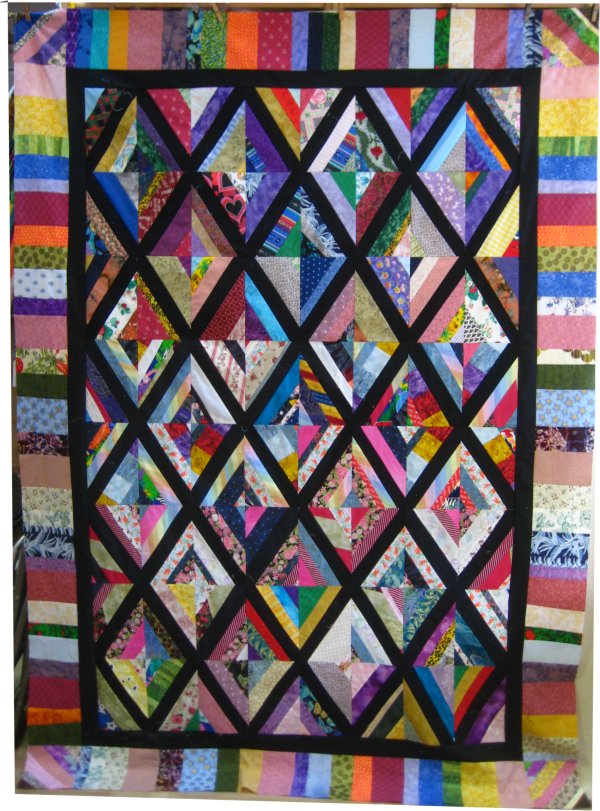
A Strings UFO - finished


The next victim of my UFO rampage is a "strings" quilt. 

I originally started these blocks in 2006.   The pattern was provided by an About.com Quilting forum member, Becky in Suriname.  At that time, I made 40 blocks and then put the project away.  The reason?  I haven't a clue.  Maybe I got bored with the block construction.  It certainly is mindless sewing .. and if you need to do sewing of that sort, this is the block to do!

In any case, I definitely needed to make more blocks.
this is a block "set"

The block is 6"x9", certainly an oddball size.  The reason why it's *that* size is because I remember going through my stash and pulling all the thinner, plain cottons and polycottons.  A 6x9 block was the biggest I could cut out of one of the pieces, so that became the size of the foundation fabric.  For this pattern, it really does NOT matter what size your block is ... just that all the blocks are the same size.

I'm using the sew-n-flip technique ... the black diagonal strip is laid down first then all the other strips are sewn onto it.  As long as you have the right length for where the strip is being sewn, it's a great scrap buster method.  Of course, if you use a bigger block, you'll bust your scraps more rapidly than I am .. which seems to be at a snail's pace. :-)

This particular pattern calls for 8 blocks in a row ... 4 sets of 2 blocks each and you need to make sure that the black diagonals oppose each other!   Then a total of 8 rows creates the major part of the quilt. 


When it came to sewing the blocks (and then the rows) together, theoretically, all those black strips in the middle are *supposed* to meet up and form perfect diamond. 

 Yeah, like that really happens.  It became obvious that I wasn't being OCD-careful in the placement of the central black strip because, in several cases, those black strips most definitely did NOT meet up nicely.  There are quite a few intersections where there are jagged seams.    And I really am not going to be concerned about it. 

 This is not an heirloom quilt.  This is a quilt be used, hopefully for a long time, and as long as it gives warmth and comfort and a degree of love to the recipient, then I am going to be pleased.  Life is just too short to be too focused on creating a perfect masterpiece every time.

 Besides, I have a messload of other UFOs to get to work on!
 
2 rows sewn together
There were 40 blocks already sewn when I picked the bag out of the UFO bin; that's 5 rows.  I needed to sew 3 more rows; 3 rows x 8 blocks/row = 24 rows.  I started sewing the additional 24 blocks on 5/11/16.  After all the blocks were sewn and stitched together, I sewed on a narrow black border, to give your eyes a rest from the busy-ness of the interior. 

A piano key border was next.  This one was extra wide, at 6", but I had quite a few strips of pre-cuts that were 6" wide .. so that's why the piano key border is that width.  I varied the size of the individual segments to give some variety and finished off the corners with another sew-n-flip square.  I finished the piano key border on 5/13/2016.

Now at this point, the top is 59"x83" (almost a twin size).  There really isn't a strict standard measurement for quilt sizes but the reference sheet that I've always used states that a twin is 65"x95".   If I put a 3" black border around the whole thing, that will bring the top to 65"x89", which is close enough for me.  Having another solid strip of fabric on the outer edge of the piano key strip will also serve the purpose of holding all the seam ends together, since I didn't backstitch them.  So, I guess I have about another half hour of work left to do.  :-)

And ya know?  My stash of scraps does not seem diminished in any way.  How can I have possibly used up 15 million scraps and not see any appreciable decrease?  It truly is one of the Great Mysteries of the Universe.


Tuesday, May 10, 2016

Coloring Fabric + a zip pouch


Do you know what this is?  Of course you do.  It's a graphic black and white printed fabric.  Very basic; we've all seen and used this kind of fabric before.

Recently, I attended a local quilt show, put on by a local guild (to which I do not belong).  Pati Fried  was the featured artist.  I was fortunate to catch her in a lull in the show and she waxed eloquent about a fun idea involving color markers and fabric.

In one of her recent blog entries, she posted, " .... I will be playing with color all weekend at the show. My whole shtick has always been to inspire others to try something new. So, that is going to be the theme of the weekend from me. I will be sharing tips and tricks on how to add color to all of those wonderful black and white prints on the market today, and then show a few samples of what to do with them! ... "

She talked about how she uses the graphic black and white *fabrics* as coloring books!  She uses fabric markers and coloring crayons, both heat set, to transform the black and white into technicolor!  The effect was astounding.  What was once merely an attractive and useful graphic was now blazing with custom colored designs.

I couldn't wait to get home to try it!  From my scrapbooking and card making craft supplies, I knew I had markers, pencils and perhaps even crayons.  I knew that I also had some specific *fabric* markers but I was curious to see if any of the other markers would be suitable.  The only problem was that many of my markers are quite old; they could even be dried out, for all I knew.  A purchase of new markers was in order.. but ... just in case I didn't care for the process, I didn't want to buy expensive ones but did want ones that would color nicely.

From my local Aaron Brothers Art Mart, I ended up purchasing a couple of individual (apparently high end) Winsor & Newton markers and at the other end of the scale, some inexpensive, generic children's markers.

Once home, I began coloring in the rectangles and squares of my fabric.  I tried to remember to leave a ring of empty shapes between the markers, as a boundary, so I could know where the different markers had been used.  I had fabric markers, watercolor markers, permanent markers, watercolor pencils (I was curious how these would work) and plain colored pencils.  The watercolor pencils were applied dry and then wet with a damp brush (predictably, the color did spread beyond the graphic lines); all markers were then heat set with a dry iron.  The colored fabric was then tossed into the washing machine with laundry soap and finally dried in the dryer,

I used the following markers:
* Windsor & Newton water color markers
* Art Alternatives marker set (this was the inexpensive children's set ... 36 markers for $10)
* Fabrico by Tsukineko fabric markers
* The Fabric Marker by Marvy (this was one of my old sets, the ink was very dry)
* Crayola watercolor pencils (applied dry, then wet)
* Memory Pencils by EK Success (not watercolor pencils)
* Color Pencils by Color Art (also not watercolor pencils)
* Faber-Castell watercolor pencils (applied dry then wet)
* Zig markers

 This is what I ended up with ...
 
As was to be expected, the regular pencils were the lightest ... but they still didn't wash out!  Even the watercolor pencils didn't wash out.   The section that looks very pale and washed out (in the middle) is the areas where I used the watercolor pencils and the regular colored pencils.  So, if you wanted a very toned-down, subtle hint of color, you can achieve this effect but simply using pencils.

 The best turned out to be *both* the most *and* least expensive: Winsor & Newton markers AND the  Art Alternatives.  Those colors are vibrant and rich.  The boldly colored areas at the top and bottom of the fabric are the areas where I used these markers.

Since they are markers, if you were a proper artist or had even the least little bit of an artistic bent, you could apply heavier pressure and creating shading.  Not me though ... I'm definitely not a proper artist. :-)

So, now that I had some colored fabric that I knew would withstand laundering, I decided to make a zip pouch.  I love zip pouches ... they are SUCH fun to make.

I cut this colored fabric to use *just* the colored-in areas.  This dictated the size of my zip pouch.  I found some colorful, irregularly striped fabric that I used as the interior lining and a suitably long zipper in a greenish teal shade that I knew I was never going to use any place else.

I have a fairly large collection of instructions/tutorials for making zip pouches of different shapes.  They are all such fun to make!   But, my *all time FAVORITE* tutorial is Anna of Noodlehead's tutorial for her Open Wide Zippered Pouch.  By far, I believe this is the BEST basic zippered pouch EVER.  Why?  Simply because, as it's name says, it's "wide open".  Because Anna leaves a zipper tape tail that extends past the pouch itself, you are able to open the pouch as wide as the fabric will allow.  You have access to the entire interior of the pouch.   Other zipper applications don't allow for the pouch to be fully opened.

See how open the pouch can be?  If the zipper had stopped at the ends of the pouch, you would have had a much *smaller* opening and your access to the inside would be restricted.

I oriented the fabric so the bold, dark colors were at the top and the paler areas were at the bottom.  Because this pouch has boxed corners, which gives you a flat bottom, the pouch can stand up on its own (given proper interfacing).  The boxed corners do take up a fair bit of fabric real estate, i.e. you do lose some of the pattern to being on the bottom, but in this case, it was quite OK with me, since that was where the less interesting, paler colors were.

Digging around in my black  & white stash to see what other graphic prints I might already have.  I discovered several candidates that might work out nicely.  Seven, in fact. 

The hexagons, squares and checkerboard will absolutely work out well.  The zebra stripe might work .. or it might not.  The roller coaster and cat outlines might not.  The text print has circles that could be colored in.


However, these 2 black and white prints won't work at all; there's just nothing to color.

All in all, I'm rather pleased and intrigued by this concept.  It certainly opens more avenues for expression. :-)


Saturday, May 07, 2016

Starry Log Cabin finished.


TA DA!  I'm so doggone pleased with myself!  :-)  From being in a UFO bin since late 2014, I pulled this project out into the light of day late April 2016 and it is completely FINISHED as of May 6, 2016!  I mean .. labeled and bound!  Woo hoo!

You can read about the first post here.


I wasn't sure exactly what to do in the sawtooth stars.  I ended up doing a loopy petal sort of design, but the middles came out rather messy, as I wasn't very accurate about where all the stitches met together.  So, to disguise this lack of preciseness, I appliqued small circles in the middle of every sawtooth star.  Who's to say they weren't originally supposed to be there?  :-)


I put off appliqueing the Christmas Tree until I knew whether or not my daughter actually liked this project.  I've gotten 'burned' on some projects, so if there is any doubt at all in my mind, I ask first. :-)   It's OK with me if my daughters don't care for a project .. but I need to know BEFORE I quilt it. :-)

But, she did like the look, so I proceeded with needleturn applique of the Christmas tree and some hand embroidery embellishments ... fly stitch along the lower "branches", a metallic swag and some bright shiney flowers.

For the quilting, all of the sawtooth stars and the Christmas tree got stitched in the ditch.  It just takes a LONG time to do that sort of outline stitching on a longarm.  Be aware that if you ask your longarm for stitch in the ditch, you're going to pay for it.  Literally.


As I look at the photo of the finished front, I see that I STILL FORGOT the Christmas tree topper!  Sheesh!
The float border was quilted in undulating feathers.  The red part of the log cabin blocks got hearts with feathers around the outside.  The white part of the log cabin blocks (which forms the background for the Christmas tree) got a clamshell filler that flattened that part of the quilt, allowing the Christmas tree to puff up a bit.  Because the Christmas tree is a fairly large expanse of fabric, I also quilted a swag line inside the tree.


I was fortunate when it came to the backing ... because my favorite youngest daughter just MIGHT want to use this as a small (very small at 42" square) personal throw whilst sitting on the couch or a chair, I wanted a cozy backing.  I had some leftover flannel from previous projects .... just that none of them were the right size or shape.  The white flannel got widened by inserting a red flannel strip.  Then that entire piece got lengthened by adding on a piece of lime green flannel, which absolutely, perfectly matched the green used in the front.  I haven't a doggone clue how I came to be in possession of such a color ... it it totally outside my color palette .. but I'm glad it was there because I used the entire thing up!  :-)

And just in case she would like to use it as a wall-hanging, I put a hanging sleeve on it. :-)


Sunday, May 01, 2016

Starry Log Cabin: the next UFO project


The next project I pulled out of my UFO bins was a small (42" square) quilt/wall-hanging.  The pattern is from a Leisure Arts booklet, "Christmas Sparkle" by Mary Jane Carey of Holly Hill Quilt Designs.  Back in 2014, I bought the booklet, a fat quarter pack and some coordinating yardage to make the cover quilt.  Everything languished in a holding pattern until now.

This is an incredibly simple, easy pattern to make ... a whole bunch of sawtooth stars around the perimeter, an inner border, and a BIG log cabin interior that serves as the background for an appliqued Christmas tree.  Honestly, it took me 4 days of sporadic piecing to get the top done.  It's just that easy.

I was able to find some sizeable flannel pieces that I sewed together in a big color blocked layout for the backing. I was able to piece an oddball sized batting piece to a more useable shape.

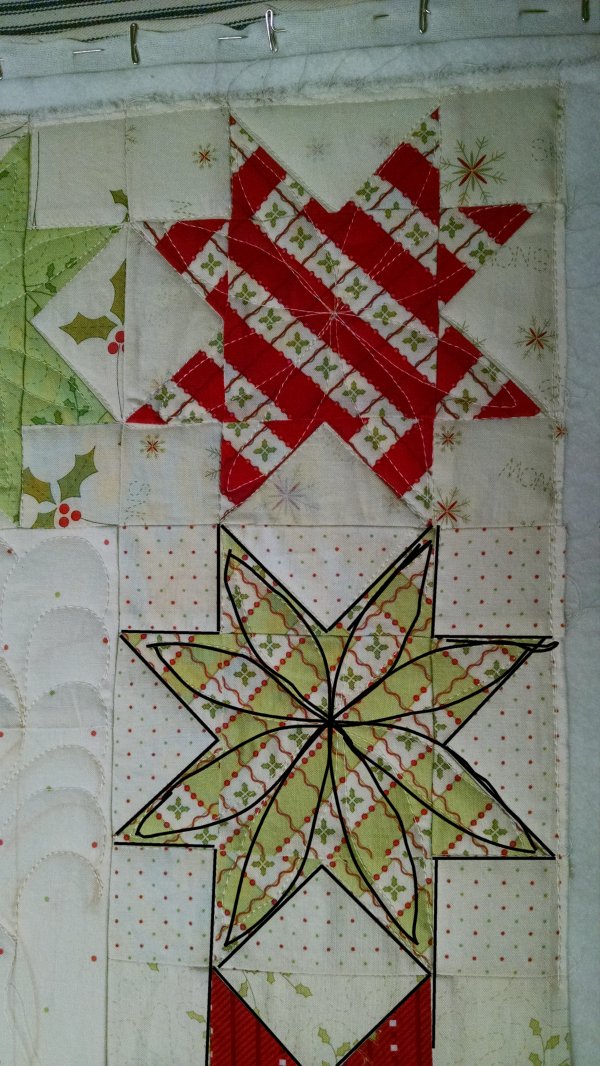
Today, 4/30/2016, I started the quilting.   I'm outline quilting the sawtooth stars and doing a loopy design in the middle of the stars.  I was pleased to find a continuous thread pathway so I could stitch the outline and loopy interior without starting and stopping.  If there's one thing I just detest about longarm quilting, it's designs that have a lot of starts and stops.

In the photo to the side, I've drawn in the quilting design on the sawtooth star in black.

 My original plan was to quilt continuous curves (aka Orange Peel) in the background fabric of the stars, but once I actually quilted the stars, I realized this would put a LOT of thread down.  More thread = a stiffer quilt ... and that is exactly what I do NOT want.

So ... the continuous curve quilting was eliminated.


The inner border gets an undulating feather design.  I've chalked in the corner curves and the spine itself. 

For me, the placement of the spine is very important.  Most of the time, I want uniform, symmetrical feathers on either side of the spine and if you get the spine placed weirdly, you get weird feathers.

You can see the chalked in corners and spine in this photo, but the chalk will wash out.